
Learn why fake Shilajit can be dangerous and how high risk products from authentic Himalayan Shilajit. Discover purification testing and authenticity factors.
Sikmma Research Team | Reviewed by: Sikmma Group Research Team
Sikmma Shilajit — Authentic vs Fake, Know the Risks, Choose Pure and Safe
Why Fake Shilajit Can Be Dangerous and How to Identify Authentic Resin
The growing popularity of Himalayan Shilajit has created massive demand across wellness markets worldwide. More people now search for authentic resin to support energy, focus, recovery, and daily wellness.
Unfortunately, this rapid demand has also increased the number of fake, poorly purified, and imitation products entering the market.
Many buyers assume all Shilajit products on the market are similar, but in reality there can be major differences between authentic purified Himalayan resin and low-quality marketplace products.
This is why understanding product quality, purification, and lab verification has become increasingly important.
Key Takeaways
- Fake Shilajit products are increasingly common in online markets
- Poor purification may affect product quality and safety
- Authentic resin should be independently lab tested
- Heavy metal screening is important for transparency
- Unrealistic fulvic acid claims are common in fake products
- Proper sourcing and purification strategy affect authenticity
Table of Contents
- Why Fake Shilajit Is Increasing
- What Makes Authentic Shilajit Different
- Common Problems With Fake Shilajit
- Why Purification Is Important
- Why Laboratory Testing Matters
- Understanding Heavy Metal Screening
- Unrealistic Fulvic Acid Claims
- How to Identify Authentic Resin
- Real vs Fake Shilajit Comparison
- How to Choose Authentic Shilajit
- Frequently Asked Questions
- Final Thoughts
Why Fake Shilajit Is Increasing
The worldwide demand for Shilajit has grown rapidly over recent years.
Many sellers now enter the market with:
- Unverified products
- Synthetic mimics
- Poorly purified resin
- Aggressive marketing claims
Some marketplace products focus heavily on:
- Low pricing
- Exaggerated claims
- Unrealistic purity percentages
Instead of scientific transparency and product verification, this has made it more difficult for buyers to identify authentic Himalayan resin.
What Makes Authentic Shilajit Different
Authentic Himalayan Shilajit is naturally formed over centuries in high-altitude mountainous environments.
Real resin naturally contains:
- Fulvic acid
- Humic substances
- Trace minerals
- Organic compounds
Authentic products usually focus heavily on:
- Careful sourcing
- Controlled purification
- Laboratory verification
- Transparency
Common Problems With Fake Shilajit
Low-quality or fake products may involve:
- Artificial additives
- Poor purification
- Excessive industrial heating
- Synthetic fillers
- Contamination risks
Some fake products may also:
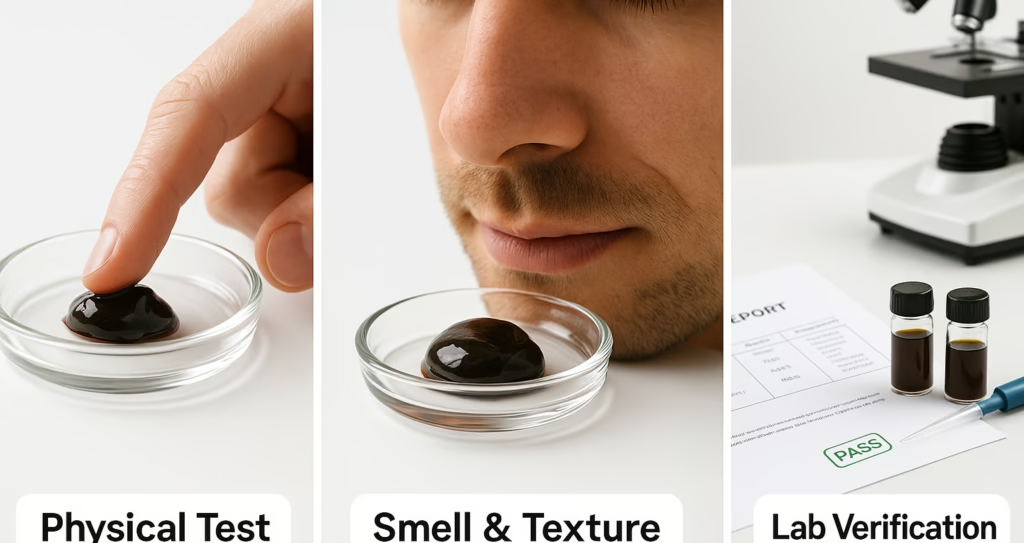
- Smell strongly chemical
- Dissolve poorly
- Appear artificially shiny
- Use fake laboratory reports
This is why buyers should always focus on transparency instead of marketing claims alone.
Why Purification Is Important
Raw mountain resin naturally contains:
- Impurities
- Plant residue
- Sand particles
- Environmental contaminants
Purification is one of the most important stages in producing authentic Shilajit.
Careful purification helps preserve:
- Natural mineral composition
- Resin consistency
- Organic compounds
- Overall product quality
Traditional purification and controlled drying methods often require significant time. Rapid industrial heating methods may negatively affect natural resin quality.
Why Laboratory Testing Matters
Third-party laboratory verification helps improve:
- Transparency
- Authenticity
- Consumer confidence
Proper testing may include:
- Heavy metal analysis
- Microbial testing
- Contamination screening
- Mineral profile analysis
- Fulvic acid evaluation
Advanced laboratories commonly use ICP-MS testing for trace element and heavy metal screening.
Understanding Heavy Metal Screening
Heavy metal screening is an important part of product verification.
Advanced laboratories test for elements such as:
- Lead
- Arsenic
- Cadmium
- Mercury
ICP-MS testing allows laboratories to measure these elements at extremely low levels with high precision, improving transparency and helping verify product safety standards.
Unrealistic Fulvic Acid Claims
Many fake products advertise claims such as “70% to 80% fulvic acid” or “instant purification” — claims that are often unrealistic.
This is because testing methods vary between laboratories, purification quality strongly affects composition, and exaggerated marketing is common in low-quality products.
Authentic Shilajit quality depends on genuine purification, mineral composition, source authenticity, and laboratory verification — not marketing percentages alone.
How to Identify Authentic Resin
Authentic Himalayan resin usually has:
- Earthy aroma
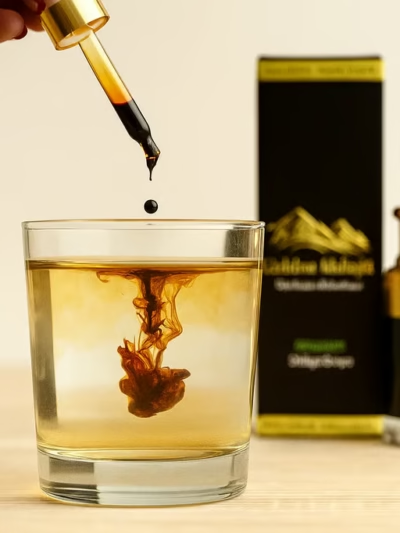
- Gradual warm-water dissolution
- Natural resin consistency
- Transparent laboratory verification
Low-quality products often show:
- Excessive residue
- Artificial smell
- Unrealistic claims
- Poor transparency
Real vs Fake Shilajit Comparison
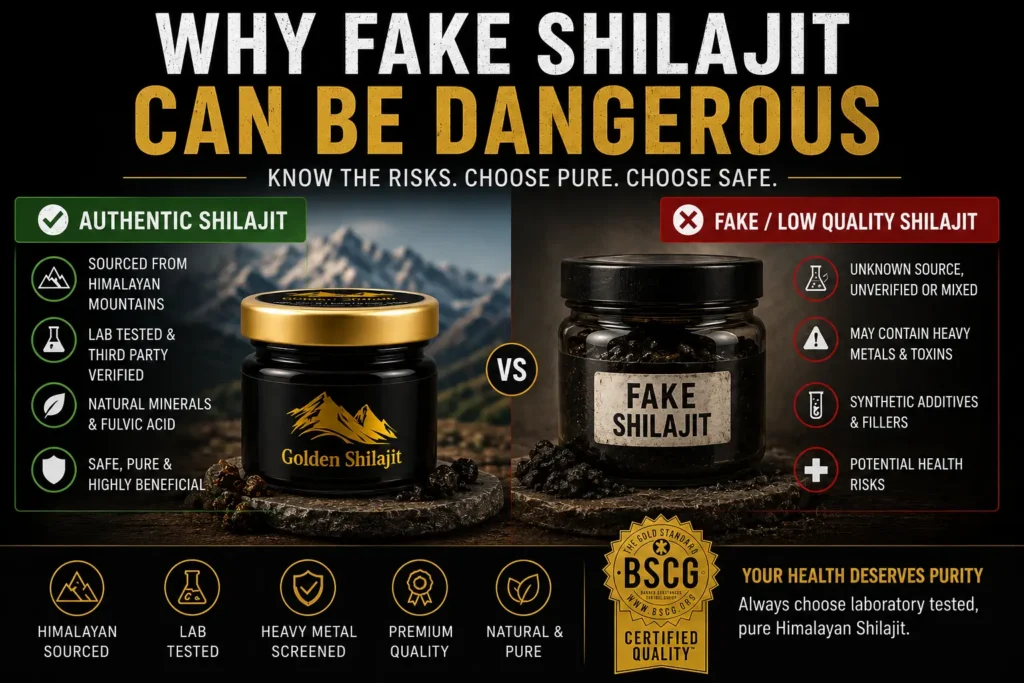
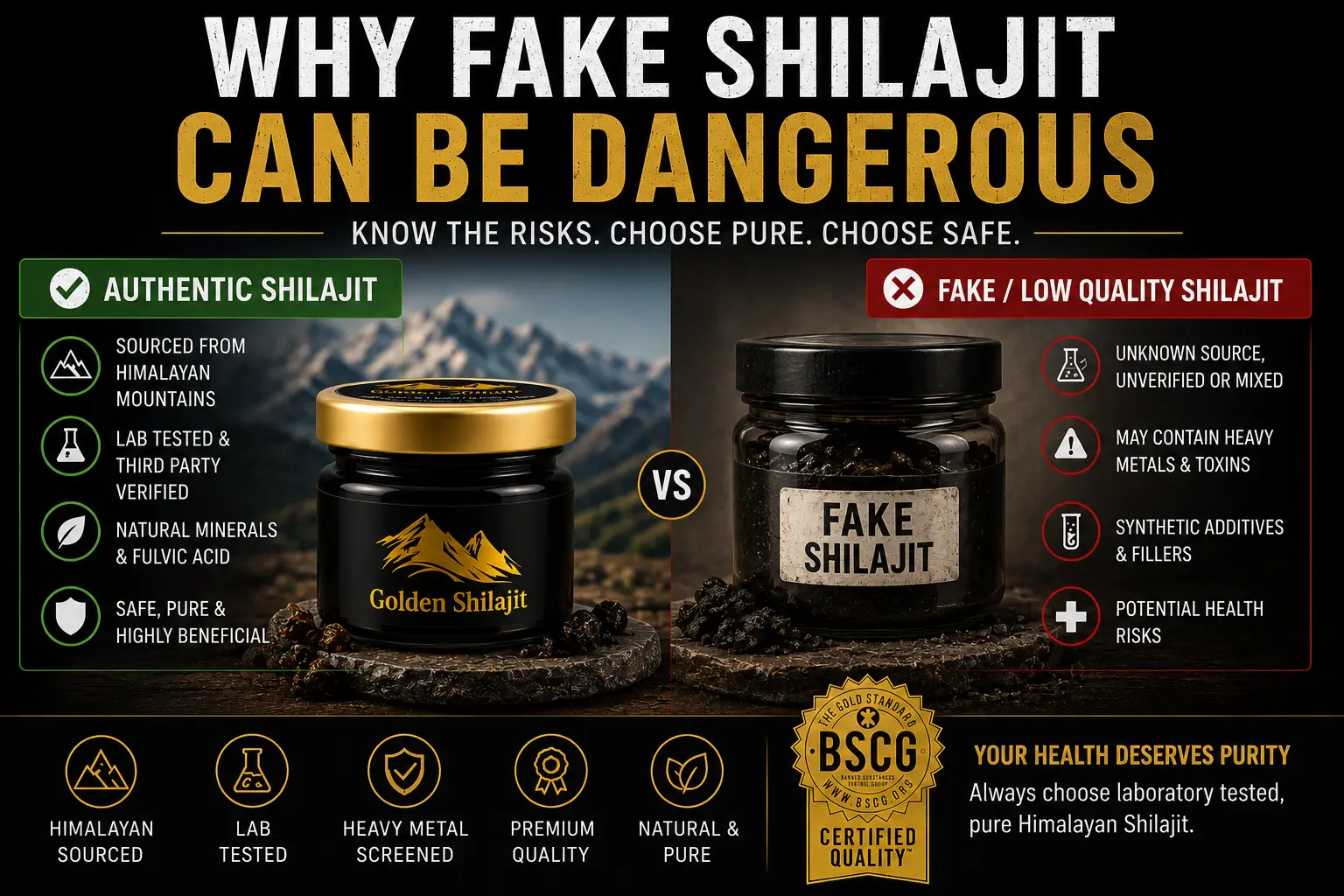
Authentic Shilajit:
- Source: Himalayan mountains
- Testing: Third-party verified
- Purification: Slow-controlled process
- Dissolution: Gradual and natural
- Smell: Earthy and mineral
- Texture: Natural and consistent
- Transparency: Clear testing details
Low-quality products:
- Source: Often unverified
- Testing: Often absent
- Purification: Rapid/industrial processing
- Dissolution: Excessive residue
- Smell: Artificially strong or chemical
- Texture: Inconsistent
- Transparency: Marketing-focused claims
How to Choose Authentic Shilajit
Before purchasing Shilajit, please look for:
- Laboratory reports
- Sourcing information
- Purification details
- Verified heavy metal testing
Avoid products that:
- Provide no testing documentation
- Make unrealistic claims
- Focus heavily on low pricing
For official products and information, please visit our website.
Frequently Asked Questions
Why is fake Shilajit common?
Growing demand and low production costs have increased the number of low-quality products in the market.
Why is purification important?
Purification helps remove impurities and improve overall product quality.
Why are laboratory reports important?
Laboratory testing helps verify purity, safety, heavy metal screening, and authenticity.
What is ICP-MS testing?
ICP-MS is an advanced testing method used for heavy metal and trace element analysis.
Why do fake products often use unrealistic claims?
Aggressive marketing is commonly used to attract buyers without genuine scientific transparency.
Final Thoughts
The increasing popularity of Himalayan Shilajit has increased the number of fake and poorly purified products in the market.
Authentic, real quality resin depends heavily on:
- Responsible sourcing
- Proper purification
- Laboratory verification
- Transparency
To buyers seeking authentic, lab-tested Shilajit, understanding how real Shilajit differs from imitation resin can help make more informed and confident purchasing decisions.